AgentGPT Review 2026
Browser-based autonomous AI agent that breaks down goals into tasks and executes them independently.
Best for: Non-developers experimenting with autonomous AI agents
Key Takeaways
- AgentGPT was a landmark demonstration of browser-based autonomous AI agents — 35,000+ GitHub stars at peak
- Development stopped in November 2023 and the parent company Reworkd AI pivoted away in July 2024
- 130+ unaddressed GitHub issues, outdated model integrations, and no active maintenance make it unsuitable for new projects
- The zero-setup browser experience was its breakthrough: name an agent, give a goal, watch it decompose and execute
- Valuable as a learning artifact and historical reference point — not as a production tool in 2026
What Is AgentGPT?
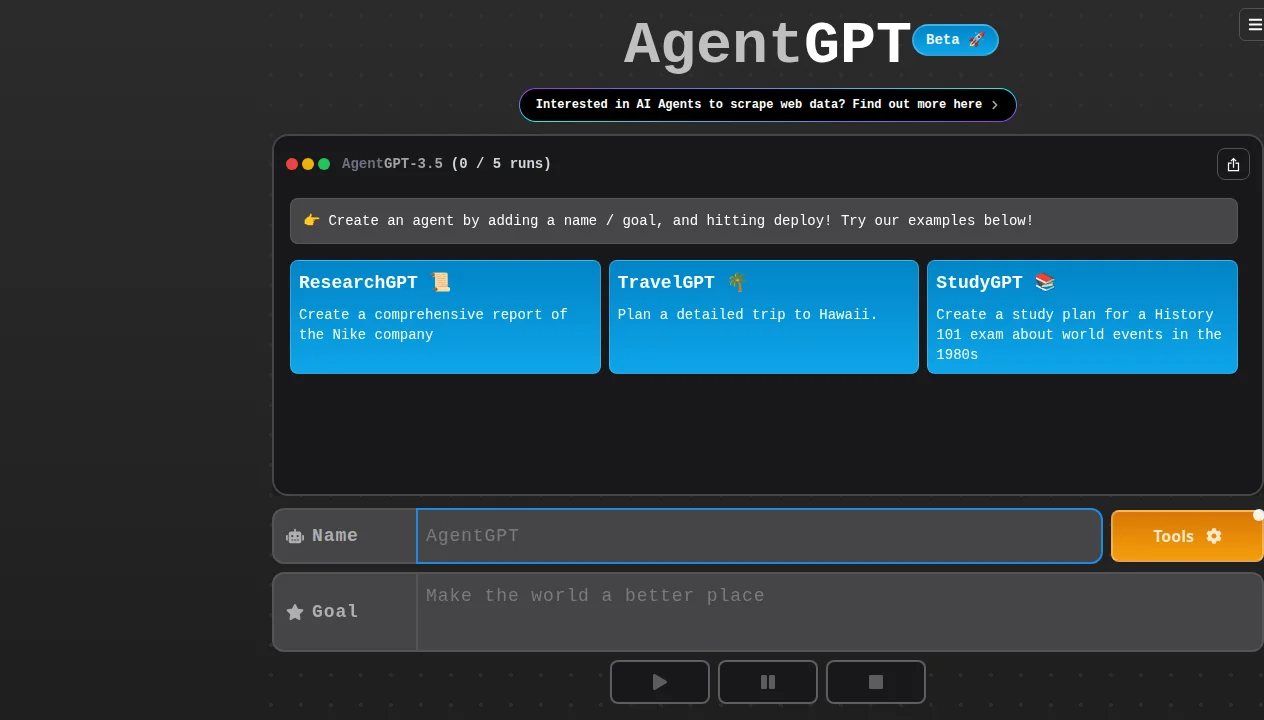
AgentGPT is a browser-based autonomous AI agent platform built by Reworkd AI. At its launch in early 2023, it was among the first tools to make the concept of goal-directed autonomous agents accessible to non-engineers: you open a webpage, type a name for your agent and a goal for it to pursue, and watch it decompose the goal into tasks, execute them sequentially, evaluate results, and iterate — entirely in your browser, with no installation, no API keys (for basic usage), and no code required.
The impact was immediate and significant. AgentGPT accumulated 35,000+ GitHub stars, became a reference point in the discourse around autonomous AI, and introduced millions of people to what agentic AI could look like before the term "AI agent" became mainstream vocabulary. It sits alongside AutoGPT and BabyAGI as a historically important project that shaped how the industry thinks about goal-directed AI systems.
That history is also the most important thing to understand about AgentGPT in 2026: it is a museum piece. Development stopped in November 2023. The parent company, Reworkd AI, pivoted away from the product in July 2024. As of this writing, there are over 130 unaddressed GitHub issues, the model integrations reference outdated versions, and no maintainer is actively working on the codebase. AgentGPT still works — the browser interface loads, agents run — but it is running on borrowed time against a foundation that hasn't been touched in over two years.
This review covers AgentGPT honestly: its historical significance, what it does (and did) well, and the clear-eyed assessment of why you should not build anything new on it. For active alternatives, see our reviews of CrewAI, LangGraph, and AutoGen.
What AgentGPT Actually Does
The core user experience of AgentGPT is elegantly simple. You navigate to agentgpt.reworkd.ai in a browser. You give your agent a name ("ResearchBot", "MarketAnalyst", "CodeHelper") and a goal expressed in plain English ("Research the top 5 competitors to [company X] and summarize their pricing"). You press deploy. The agent starts running.
Under the hood, AgentGPT runs a task decomposition loop:
Step 1 — Planning: The agent calls an LLM with the goal and asks it to break the goal into a prioritized list of tasks.
Step 2 — Execution: The agent takes the first task, calls an LLM (and optionally tools like web search) to complete it, and records the result.
Step 3 — Evaluation: The agent reflects on what was accomplished and determines the next task, looping back to Step 2.
Step 4 — Completion: The loop terminates when all tasks are marked complete or when a maximum iteration count is reached.
This loop — sometimes called the ReAct pattern (Reason + Act) or simply "task decomposition" — is now the foundation of nearly every modern agent framework. In early 2023, seeing it execute in a browser with a clean UI was genuinely revelatory. It made the abstract concept of autonomous AI concrete and accessible in a way that code examples couldn't.
What AgentGPT Got Right
Zero Setup Barrier
The decision to make AgentGPT entirely browser-based was a masterstroke of accessibility. No Python environment, no Docker, no API keys, no configuration files — just a URL. This removed every technical barrier between a curious non-engineer and their first experience with an autonomous AI agent. That frictionlessness is why AgentGPT reached millions of users when code-first alternatives reached thousands.
Intuitive Goal-Setting UX
The "name your agent, state your goal" interface maps directly to how people think about delegating work. You don't need to know about system prompts, temperature parameters, or context windows — you describe what you want achieved, and the agent figures out how. This natural-language interface design influenced the UX of many later products, including some no-code agent builders that are still in active development.
Visual Task Execution
Watching AgentGPT decompose a goal into tasks and execute them one by one — seeing the intermediate reasoning and partial results — was more educational than most documentation. It made the internal mechanics of agent loops visible in a way that built genuine intuition. For learning about how agents work, this visualization is still one of the better pedagogical tools available, even from a codebase that hasn't been updated in two years.
Open Source with a Template Library
AgentGPT ships with a library of pre-built agent templates covering common use cases: market research, content creation, code review, data analysis. These templates lower the bar further for new users and serve as useful starting points for understanding how to frame agent goals effectively. The template library is a practical acknowledgment that most people struggle with prompt engineering for agent goals, and providing good examples helps significantly.
What AgentGPT Gets Wrong (And Why It's Abandoned)
Development stopped November 2023: This is the fundamental problem. The core codebase hasn't received meaningful new features in over two years. In an ecosystem that moves as fast as AI agents, two years of stasis is not just "behind" — it's obsolete. The gap between what AgentGPT can do and what current frameworks (CrewAI, LangGraph) can do is enormous.
Reworkd AI pivoted July 2024: The parent company that built AgentGPT made a deliberate strategic decision to move away from the product and focus on other areas. This isn't a project waiting for a motivated contributor to revive it — the organization behind it has moved on. The GitHub repository is effectively in archival mode.
130+ unaddressed GitHub issues: The open issues include real bugs (broken tool integrations, authentication failures, rate limit handling problems) and feature requests that accumulated after development stopped. None of them have been addressed. Users encountering these bugs have no recourse — no maintainer will fix them.
Outdated model integrations: AgentGPT's model integrations target versions of the OpenAI API from 2023. Many model versions it was built around have been deprecated or removed. The integration code needs updating for current API versions, and that work isn't being done. Reliability degrades over time as the underlying APIs change.
Limited real-world reliability even at peak: Even at launch, AgentGPT's task decomposition loop had a well-known failure mode: it would spin up tasks, partially complete them, generate subtasks that made no progress, and either loop indefinitely or terminate with shallow results. The framework lacked the evaluation and error handling needed for reliable task completion on anything but simple, well-scoped goals. Production use was always more demo than dependable.
Pricing
AgentGPT is free via the hosted browser interface and free to self-host (MIT licensed). Basic usage on the hosted platform requires no API key. Bringing your own OpenAI API key via the settings panel enables access to better model versions and removes shared queue rate limits. Self-hosting requires Docker and a reasonably modern server — the README provides setup instructions that, as of 2023, were straightforward.
There is no paid tier, no enterprise offering, and no commercial support. There never was, and given the project's status, there never will be.
Should You Use AgentGPT in 2026?
For learning and experimentation: Yes, with clear expectations. AgentGPT is still an excellent demonstration of autonomous agent loops. Running it with your own API key and observing how it decomposes goals, what it does well, and where it fails will build your intuition about agent systems. The source code is worth reading for the same reason.
For education and demos: Yes, with caveats. If you're teaching a course or giving a talk about AI agents and want a no-install demo that a non-technical audience can run, AgentGPT still works for simple, well-scoped goals. Just don't expect reliability on complex tasks.
For any production use: No. Emphatically not. An abandoned codebase with 130+ open bugs, outdated API integrations, and no active maintainer is not a foundation for anything that needs to work reliably. The alternatives — CrewAI, LangGraph — are better in every measurable dimension for actual use.
For self-hosting: Technically possible, but the opportunity cost of maintaining a fork of an abandoned codebase far exceeds the benefit. You'd spend more time debugging compatibility issues than actually using the tool. Use a maintained framework instead.
Our Verdict
AgentGPT earns a 3.2/5 from us — a score that reflects historical significance and genuine innovation, offset heavily by its current abandoned state. The score would be higher evaluated purely on what it achieved in 2023; it would be lower evaluated purely on whether you should use it today. The 3.2 represents the honest composite: it matters, it worked, it's done.
AgentGPT deserves credit as one of the projects that made autonomous AI agents legible to a broad public. Its zero-install, browser-native approach influenced how the industry thinks about agent accessibility. The task decomposition loop it popularized is now the foundation of the entire agent framework ecosystem. That legacy is real.
But legacy doesn't mean current. The honest recommendation for anyone looking to build with agent technology in 2026 is to start with an actively maintained framework. CrewAI offers the fastest path to a working multi-agent system. LangGraph offers the most precise control. Both are actively developed, well-documented, and have communities that will be around to help when things go wrong. AgentGPT is a monument to how far the field has come — not a tool to build the next chapter on.
Pros & Cons
Pros
- No installation required (web-based)
- Extremely easy to use
- Good for simple autonomous tasks
- Open-source version available
- Quick prototyping
Cons
- Limited capabilities vs coding frameworks
- Can go off-track on complex tasks
- Free tier very limited
- Less control than code-based agents
Our Ratings
Verdict
AgentGPT earns a strong 4/5 in our testing. It is a solid choice for non-developers experimenting with autonomous ai agents, offering a good balance of features and accessibility.
With a free tier available, there is very little risk in trying it out. If you are evaluating AI frameworks, AgentGPT deserves serious consideration.
Frequently Asked Questions
Is AgentGPT still working in 2026?
Is AgentGPT open source?
What happened to Reworkd AI, the company behind AgentGPT?
What should I use instead of AgentGPT?
Can I use AgentGPT without an API key?
Sources & References
- AgentGPT Web Application· Official hosted browser interface for AgentGPT
- AgentGPT GitHub Repository· Open-source codebase and issue tracker showing maintenance status
- NeonRev — AgentGPT Autonomous AI Guide· User guide covering setup, features, and practical limitations
- DataCamp — AgentGPT Tutorial· Hands-on tutorial with examples of goal-directed agent tasks
- AI Agents List — AgentGPT· Community directory listing with feature overview and user ratings

Written by Marvin Smit
Marvin is a developer and the founder of ZeroToAIAgents. He tests AI coding agents daily across real-world projects and shares honest, hands-on reviews to help developers find the right tools.
Learn more about our testing methodology →Related AI Agents
CrewAI
Open-source framework for orchestrating role-playing autonomous AI agents working together as a crew.
Read Review → →AutoGen (Microsoft)
Microsoft's open-source framework for building conversational multi-agent systems with human feedback.
Read Review → →LangGraph
LangChain's graph-based framework for building stateful, cyclic agent workflows with loops and persistence.
Read Review → →