Google Vertex AI Agent Builder Review 2026
Google Cloud's platform for building AI agents with Gemini, optimized for enterprise search and chat.
Best for: Enterprises on Google Cloud building search and chat agents
Key Takeaways
- Google Vertex AI Agent Builder provides Google Cloud scale and Gemini-native integration — the strongest foundation for high-throughput enterprise agent deployments
- Agent-to-Agent (A2A) protocol and Memory Bank are technically ahead of most competitors — Google is defining the standards, not following them
- Pricing complexity (vCPU hours, memory GB-hours, session events all billed separately) is a genuine barrier — budget modeling requires engineering involvement
- $300 free trial credits make it the most accessible major cloud AI platform for experimentation before commitment
- The steep learning curve and GCP dependency make this the right choice for engineering teams, not business analysts looking for low-code accessibility
What Is Google Vertex AI Agent Builder?
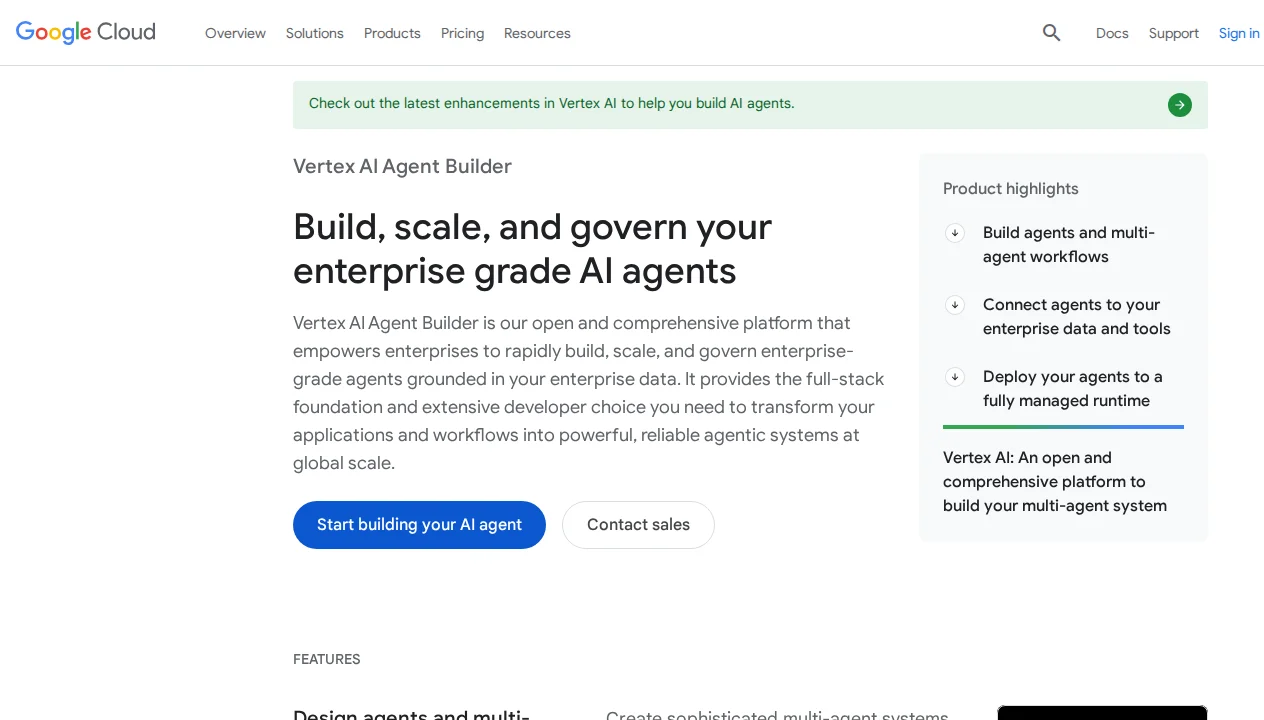
Google Vertex AI Agent Builder is an enterprise platform on Google Cloud Platform (GCP) for building, deploying, and orchestrating AI agents at scale. Part of the broader Vertex AI managed ML platform, Agent Builder provides the infrastructure layer for creating agents that can reason, access data, use tools, maintain long-term memory, and coordinate with other agents — all backed by Google's cloud infrastructure and integrated with the Gemini family of models.
Launched in its current form in 2025 and updated through early 2026, Vertex AI Agent Builder targets engineering teams building production-grade agent systems. It is not a low-code tool for business analysts — it is a cloud infrastructure platform that trades accessibility for power, flexibility, and scale. If you're evaluating it alongside more accessible alternatives, our guide on how to choose the right AI agent platform helps frame the decision between developer-focused infrastructure and business-user-friendly tools.
My evaluation draws on hands-on exploration of Agent Builder's configuration and deployment capabilities, Google's official technical documentation, and analysis of third-party developer assessments published through early 2026.
Getting Started
Access starts at Google Cloud Console. New Google Cloud accounts receive $300 in free credits — a meaningful head start for experimentation that covers substantial agent development and testing before any billing begins. Existing GCP accounts can enable Agent Builder as a service within minutes from the console.
The initial setup requires GCP familiarity: enabling the Vertex AI API, configuring service accounts and IAM roles, selecting a project and region, and understanding the billing model before deployment. For teams already working in Google Cloud, this is routine. For organizations evaluating cloud-based AI agents for the first time, this represents a non-trivial onboarding investment. Unlike Microsoft Copilot Studio or Intercom Fin, there is no guided "wizard" experience — Agent Builder assumes users understand cloud infrastructure concepts.
Key Features in Depth
Agent-to-Agent (A2A) Protocol
Google's Agent-to-Agent (A2A) protocol is one of the most technically significant contributions to the AI agent space in 2025-2026. A2A defines a standardized communication protocol for AI agents built on different frameworks and by different teams to discover each other's capabilities and coordinate on tasks. Where most multi-agent orchestration today requires tight coupling between agents — shared code, shared data stores, coordinated deployments — A2A enables loosely coupled agent networks where agents communicate via structured capability advertisements and task requests.
The practical implication for enterprise deployments is significant. A customer service agent, an order management agent, and a payment processing agent — potentially built by different teams, using different underlying models, running on different infrastructure — can collaborate on a complex user request via A2A without requiring a shared codebase or centralized orchestration platform. This is the architecture for genuinely enterprise-scale multi-agent systems, and Google building it as an open protocol positions Vertex AI Agent Builder at the center of that ecosystem.
A2A support is early-stage in early 2026 — the protocol is defined and reference implementations are available, but broad third-party adoption is still developing. Organizations building on this today are on the leading edge, with the inherent benefits (architecture influence, early mover advantage) and risks (specification evolution, limited community support) that entails.
Memory Bank for Long-Term Context
Memory Bank is Vertex AI Agent Builder's solution to one of the core limitations of LLM-based agents: the inability to retain information across separate conversation sessions. By default, LLM conversations are stateless — each session starts fresh, with no access to what was discussed last week or what actions were taken last month. Memory Bank provides a persistent, queryable store of agent memories that can be accessed across sessions.
In practice, this enables agents that genuinely improve over time and maintain personalization at scale. A customer support agent with Memory Bank enabled can remember that a specific customer has repeatedly called about the same issue, that a previous resolution didn't work, and what their stated preferences are — without requiring the customer to re-explain their context each time. For enterprise deployments where agent quality compounds with usage, Memory Bank is the infrastructure that enables this.
Memory Bank uses vector embedding for semantic retrieval, meaning queries retrieve contextually relevant memories rather than requiring exact matches. The memory management interface allows administrators to review, edit, and delete stored memories — critical for GDPR compliance and privacy management in customer-facing deployments.
Tool Governance via Cloud API Registry
Vertex AI Agent Builder's integration with Google Cloud API Registry provides centralized governance over the tools and external APIs that agents can access. Rather than each agent team independently managing API credentials and defining tool schemas, Cloud API Registry creates a catalogued, version-controlled inventory of approved tools that agents can be granted access to through standard IAM policies.
For organizations managing dozens of agents across business units, this governance layer prevents the fragmentation that emerges when each agent team independently manages its external integrations. Security teams can audit which agents have access to which external services, apply policies at the registry level rather than agent by agent, and maintain a versioned history of tool definitions. This is enterprise governance tooling that justifies Vertex AI Agent Builder's position as an infrastructure platform rather than just an agent creation tool.
Gemini Integration
Native Gemini integration is the most commonly cited advantage of Vertex AI Agent Builder over cloud-agnostic agent platforms. Gemini 2.5 Pro (as of April 2026) is Google's most capable model for reasoning and complex task completion, and accessing it through Vertex AI provides: lower latency than API calls from external services, Vertex AI's enterprise SLAs and data residency guarantees, fine-tuning capabilities that aren't available through the public Gemini API, and integration with Google Cloud's broader data and analytics stack (BigQuery, Cloud Storage, Cloud SQL).
Organizations already using Google Cloud for data infrastructure benefit from agents that can query BigQuery datasets, access Cloud Storage documents, and call Cloud Functions as tools — all within Google's network without external API calls. For data-intensive agent workflows, this reduces both latency and cost compared to agents that must egress data to external platforms.
Pricing Breakdown
Vertex AI Agent Builder's pricing is the most complex of any platform in this review category. Multiple cost dimensions apply simultaneously, making total cost of ownership modeling a non-trivial engineering task:
| Resource | Unit | Price | Notes |
|---|---|---|---|
| vCPU | Per hour | $0.0864/hour | Compute for agent execution; scales with parallelism |
| Memory | Per GB-hour | $0.0090/GB-hour | RAM consumed during agent sessions |
| Sessions | Per 1,000 events | $0.25/1K events | Session state events during multi-turn conversations |
| LLM calls (Gemini) | Per input/output token | Varies by model | Separate Vertex AI model billing on top of Agent Builder costs |
| Memory Bank storage | Per GB-month | $0.026/GB-month | Vector storage for persistent agent memories |
| Free trial | New accounts only | $300 credit | Applies to all GCP services including Agent Builder |
The challenge with this pricing model is that actual monthly costs require modeling agent session duration, LLM call frequency, Memory Bank size, and system concurrency — none of which are knowable before deployment without realistic load testing. Third-party analysis suggests production customer service agents at moderate volume (10,000-50,000 interactions/month) run $500-$3,000/month in Agent Builder and Gemini combined costs, depending heavily on agent design efficiency. See Google Cloud's official pricing page for current rates.
Vertex AI Agent Builder vs The Competition
Vertex AI Agent Builder vs Microsoft Copilot Studio: The comparison reveals a genuine developer-vs-business-user divide. Copilot Studio is more accessible, cheaper for internal use at Microsoft shops, and faster to initial deployment for business analysts. Vertex AI Agent Builder is more powerful, more flexible, better governed, and better suited for engineering teams building complex multi-agent systems on Google Cloud.
Vertex AI Agent Builder vs Salesforce AgentForce: AgentForce has the advantage when agents need deep CRM data integration within the Salesforce ecosystem. Vertex AI has the advantage when agents need broader data access across enterprise systems or when organizations want model flexibility beyond a single vendor's LLM offering.
Vertex AI Agent Builder vs Intercom Fin: These tools serve different purposes. Intercom Fin is purpose-built for customer service AI with an outcome-based pricing model that's far easier to budget for. Vertex AI Agent Builder is general-purpose infrastructure. Choose Fin if your primary use case is customer support; choose Vertex if you're building custom enterprise agent workflows beyond support.
What We Don't Like
Pricing complexity is a genuine blocker: The multi-dimensional pricing (compute + memory + sessions + LLM calls + storage) is not something a business buyer can reason about without engineering involvement. Compared to Intercom Fin's $0.99/resolution or even AgentForce's $0.10/action, Vertex AI Agent Builder's pricing model requires infrastructure expertise to forecast accurately.
Documentation accessibility: Google Cloud's documentation is comprehensive but not always navigable. Finding the right entry point for a specific agent architecture pattern often requires exploring multiple documentation sections that aren't clearly cross-linked. The documentation quality is high once found; discoverability is the issue.
GCP lock-in: The platform's best-value features — native Gemini integration, BigQuery access, IAM governance, Memory Bank — are all GCP-native. Organizations running multi-cloud or AWS/Azure-primary infrastructure won't realize the full platform value, and migrating away from Vertex AI Agent Builder to another platform involves significant rework.
Limited low-code capabilities: Unlike Copilot Studio or AgentForce, Vertex AI Agent Builder doesn't offer a business-user-friendly graphical configuration experience. Most operations require the GCP console, API calls, or code — which means non-engineering business stakeholders are dependent on engineering teams for all agent development and iteration.
Our Verdict
Google Vertex AI Agent Builder earns a 4.0/5 from us. It is a technically impressive enterprise platform with genuine innovations in multi-agent coordination (A2A protocol), long-term memory (Memory Bank), and governance (Cloud API Registry). Google Cloud's infrastructure scale and Gemini model integration make it a compelling choice for organizations building high-throughput, production-grade agent systems on GCP.
The score reflects the real challenges: pricing complexity that requires engineering involvement to model accurately, steep learning curve for teams new to GCP, and documentation navigability issues that slow initial exploration. These are not deal-breakers for the engineering teams this platform is designed for — they're the expected trade-offs of a powerful infrastructure platform prioritizing flexibility over accessibility.
The bottom line: If you're an engineering team building production AI agent systems on Google Cloud, Vertex AI Agent Builder should be your primary evaluation. If you're a business team looking for accessible agent deployment without GCP expertise, start with Copilot Studio or Intercom Fin and revisit Vertex AI when your requirements outgrow their capabilities.
Pros & Cons
Pros
- Powered by latest Gemini models
- Strong search and retrieval capabilities
- Scales with Google Cloud infrastructure
- Pay-per-use pricing model
- Good for data-heavy applications
Cons
- Requires Google Cloud knowledge
- Pricing can be unpredictable
- Less mature than competitors
- Documentation could be better
Our Ratings
Verdict
Google Vertex AI Agent Builder earns a strong 4.3/5 in our testing. It is a solid choice for enterprises on google cloud building search and chat agents, offering a good balance of features and accessibility.
With a free tier available, there is very little risk in trying it out. If you are evaluating AI enterprise, Google Vertex AI Agent Builder deserves serious consideration.
Frequently Asked Questions
What is Google Vertex AI Agent Builder?
How much does Google Vertex AI Agent Builder cost?
What is Google's Agent-to-Agent (A2A) protocol?
Do I need to use Google Cloud to use Vertex AI Agent Builder?
Is Vertex AI Agent Builder suitable for non-technical users?
Sources & References
- Google Cloud Vertex AI Pricing· Official pricing for Vertex AI Agent Builder compute, memory, session events, and models
- Lindy.ai — Vertex AI Pricing Analysis· Independent analysis of Vertex AI pricing with real-world cost modeling examples
- linkgo.dev — Vertex AI Agent Builder Pricing Structure· Developer-focused FAQ on Vertex AI Agent Builder pricing dimensions and cost calculation
- Google Cloud Agent Builder Release Notes· Official release notes covering A2A protocol, Memory Bank, and Tool Governance updates
- Hakunamatata Tech — Build AI Agents with Vertex AI· Practical guide to building and deploying agents on Vertex AI Agent Builder

Written by Marvin Smit
Marvin is a developer and the founder of ZeroToAIAgents. He tests AI coding agents daily across real-world projects and shares honest, hands-on reviews to help developers find the right tools.
Learn more about our testing methodology →Related AI Agents
Salesforce Agentforce
Enterprise AI agents deeply integrated with Salesforce CRM for autonomous customer service and sales.
Read Review → →Microsoft Copilot Studio
Enterprise platform for building custom AI copilots integrated with Microsoft 365 and Power Platform.
Read Review → →